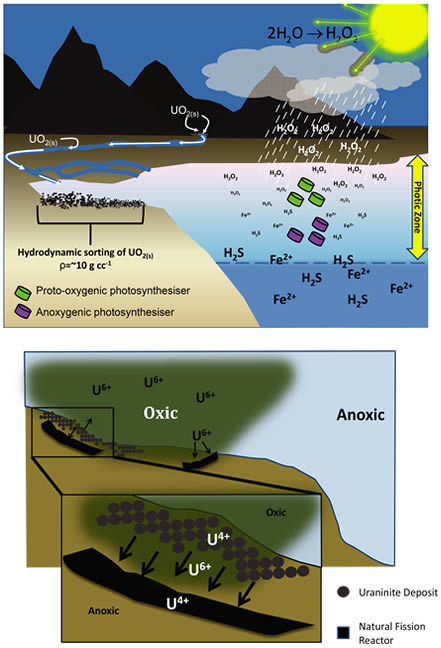
Figure 2.
Cartoon showing a possible mechanism by which oxygenic photosynthesis could lead to formation of natural fission reactors. Uraninite weathered out of igneous and metamorphic rocks is transported to isolated basins and deposited in shallow water environments, providing a ready source of U as soon as the waters become oxidizing. Photolytically produced H2O2 rains out of the atmosphere and oxidizes the uppermost water column, reducing the concentration of electron donors required by anoxygenic photosynthesizers such as H2S and Fe2+. This provides the selective pressure required for the emergence of oxygenic photosynthesis due to the abundance of H2O as an alternative electron donor. Once oxygenic photosynthesis evolves, this produces local enrichment in oxygen in the surface water. This would mobilize uranium into solution (see Figs. 3 and 4), which would be redeposited at the margins of the oxygen oasis. These uranium deposits would have the potential to form natural reactors due to the high concentration of 235U in the Archean.