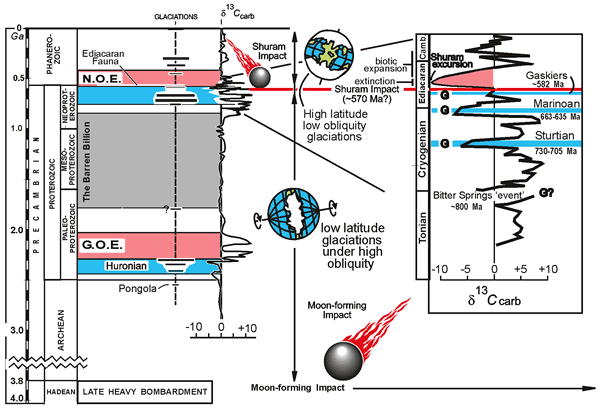
Figure 1.
Schematic depiction of some aspects of Earth’s climatic history. Note the two great Proterozoic glacial episodes (at left), each followed by an atmospheric “oxidation event.” The “barren billion” has little evidence of glaciations or iron formations. Two contrasted climatic regimes are depicted in the central part of the diagram. During most of the Proterozoic eon, glaciations appear to have been concentrated in low latitudes, possibly as a result of Earth’s high obliquity (Williams, 2008). A radical change occurred near the beginning of the Phanerozoic eon, when a putative large marine impact brought about a major shift in the orientation of the world’s spin axis, resulting in a new climatic zonation that still exists today. The impact is inferred from the Shuram δ13C anomaly (right side; modified from fig. 1 of Halverson et al., 2010) and associated stratigraphic and sedimentological evidence. Note that the Shuram anomaly and impact (age after Bowring et al., 2009) is depicted as younger than the Gaskiers glaciation (age after Mason et al., 2013, their fig. 3) but has been considered older by some. See text for full explanation. G.O.E.—great oxidation event; N.O.E.—Neoproterozoic oxidation event; G—glacial episode.