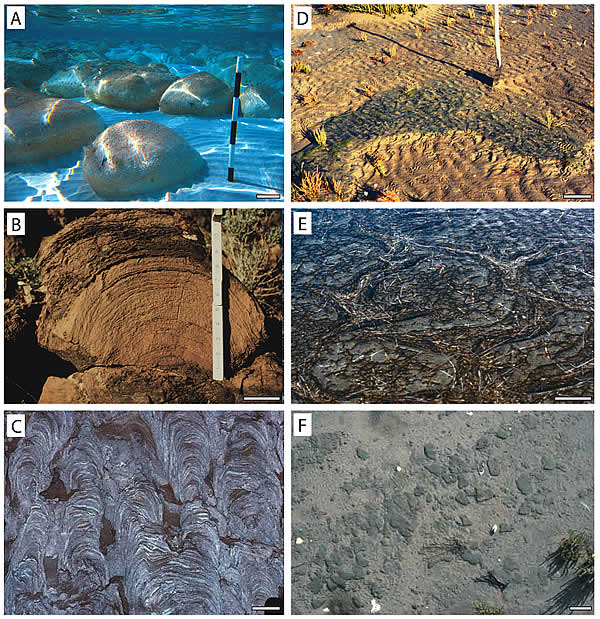
Figure 1.
Modern examples of stromatolites and microbially induced sedimentary structures (MISS). (A) Stromatolites north of Carbla Point, Shark Bay, Western Australia. The stromatolites are distinct build-ups of carbonate with vertical relief. The living microbial mat layer colonizes the surface of the stromatolite. Bar scale: 10 cm. (B) Domical stromatolite displaying stack of laminae in vertical section, Brighton Limestone, Cryogenian, South Australia. Bar scale: 5 cm. (C) Baicalia cf. rara from the Shisanlitai Formation, Neoproterozoic, Liaoning Province, China. Bar scale: 2 cm. (D) Tidal flats of Mellum Island, Germany. Erosional remnants and pockets, sometimes called “the siliciclastic answer to stromatolites.” The microbial mats are planar, projecting only to a very minor degree from the sedimentary surface. Bar scale: 10 cm. (E) Coastal sabkha Bahar Alouane, Tunisia. Polygonal oscillation cracks form in microbial mats in semi-arid climate zones. Bar scale: 10 cm. (F) Tidal flats of Fishermans Island, Virginia, USA. Microbial mat chips scattered on sandy sediment. Bar scale: 5 cm.