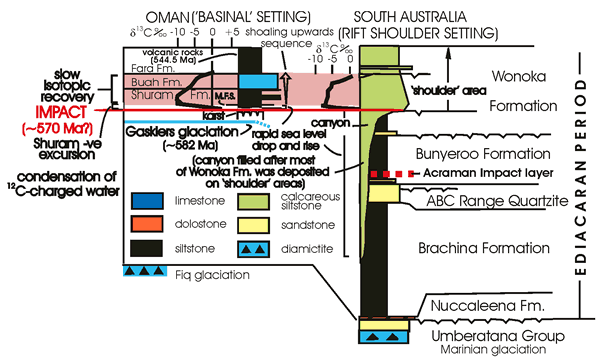
Figure 3.
Two representative sections containing the Shuram isotopic anomaly. The Oman section is simplified from Le Guerroué et al. (2006, their fig. 2), and the Wonoka section is after Christie-Blick et al. (1995, their fig. 3). See Le Guerroué et al. (2006) for sources of isotopic profiles. The sections are not to scale, but the Wonoka canyons are up to 1 km deep. The Shuram excursion (age after Bowring et al., 2009) is younger than the Acraman impact layer. The Shuram excursion is shown as younger than the Gaskiers glaciations (Bowring et al., 2007; Macdonald et al., 2013) although some (Le Guerroué et al., 2006; Halverson et al., 2010) have considered the possibility that it may be younger. Much of the fill of the Wonoka canyons occurred after deposition of most of the Wonoka Formation on adjacent “shoulder” areas (Husson et al., 2012). The karst beneath the base of the Shuram Formation is after McCarron (2000). M.F.S.—maximum flooding surface.